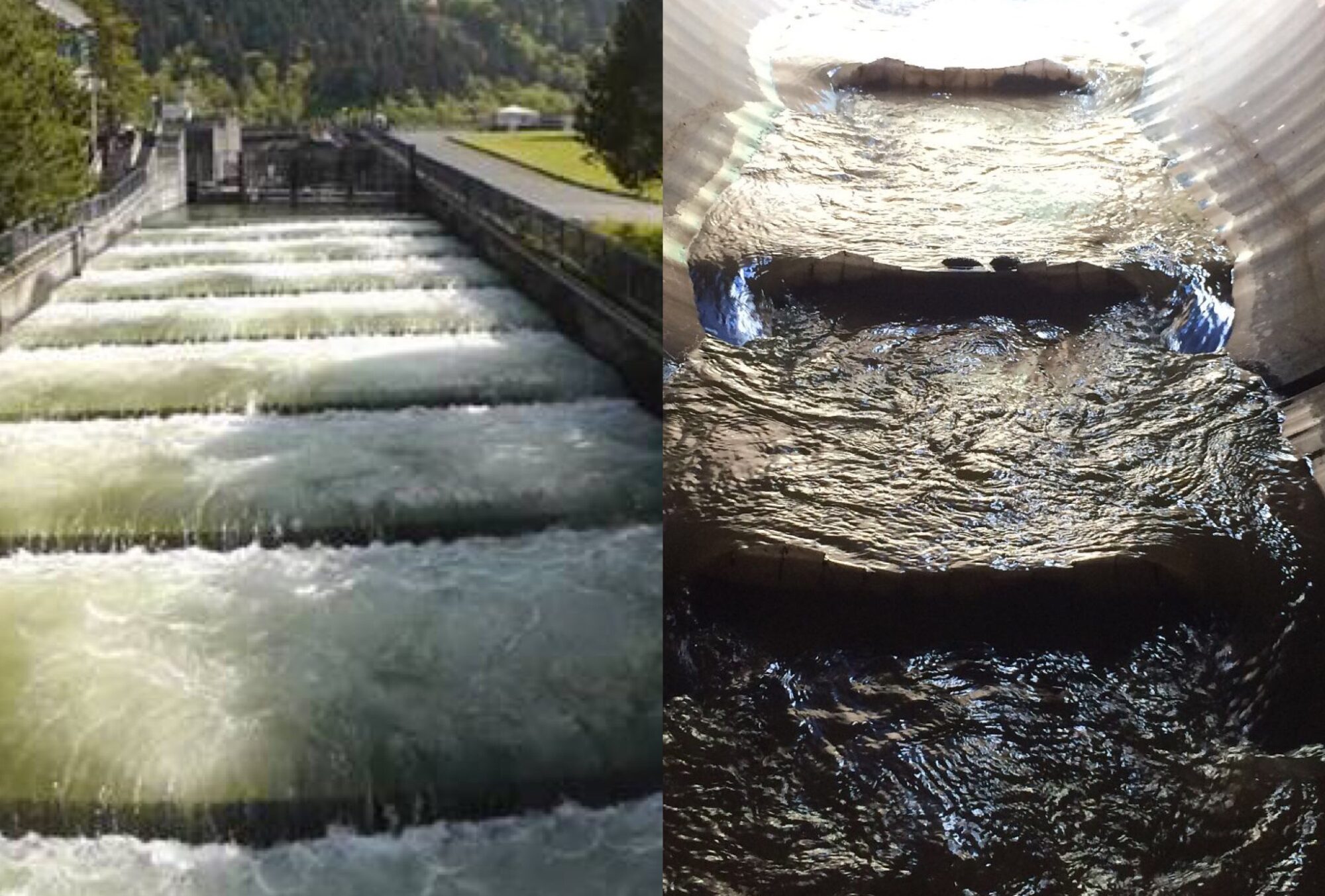

What a King County culvert inventory says about moving fish while the real repair waits for funding
By Shane Scott, Principal Biologist · SSA Environmental
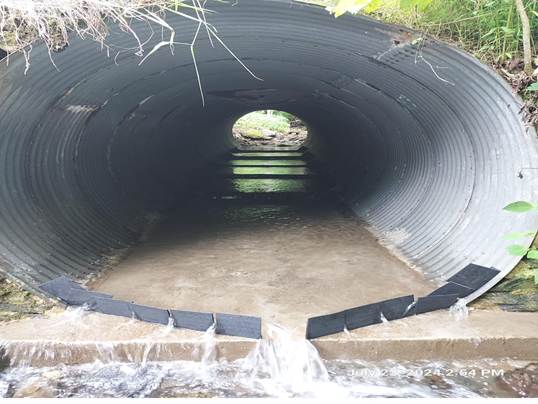
FlexiBaffles installed inside an existing culvert barrel — the interim measure that carries fish passage through the years between identifying a barrier and funding its removal.
Here’s what a culvert fish passage retrofit actually costs. I ran the numbers on eight fish-passage barriers in King County, Washington — real culverts from the WDFW inventory, each already carrying a replacement estimate. Replacing them the right way, with open-bottom structures, is estimated at about $29 million. A culvert fish passage retrofit of the same barrels — installing FlexiBaffles to move fish through them in the meantime — comes to about $29,000, roughly one-tenth of one percent of the replacement total.
That is the number worth sitting with. But before it gets misread, let me be clear about what it does — and does not — mean.
Replacement is still the goal
Full removal or replacement of a barrier culvert is the superior long-term solution. Always. An open-bottom structure restores the stream, not just the fish, and nothing here is a cheaper way out of doing it.
The problem is timing. Replacement budgets fund a handful of sites a year. A county, a DOT, or a watershed council can be looking at hundreds of barriers and know most of them won’t reach the funded list for a decade or more. In those years, the fish above the culvert simply wait. FlexiBaffle is how they stop waiting — an interim measure that carries passage through the funding queue and comes out when the culvert finally does.
What a culvert fish passage retrofit costs
FlexiBaffle is a modular flexible EPDM weir that mounts inside an existing culvert to cut velocity, add depth, and create resting zones — the in-barrel conditions that stop weak or small fish. Retrofitting a barrel is a grant line item, not a capital program.
At Bon Accord Creek in Surrey, BC, coho reached spawning habitat for the first time in almost 70 years after a baffle retrofit — proof that the interim fix moves fish while the culvert waits its turn for removal.
I paired the WDFW culvert inventory with King County’s own replacement estimates and sized a retrofit for each site using the manufacturer’s sizing and spacing tables. Here is how it came out:
| Stream (Road) | Retrofit | Replacement | In-barrel fit |
| Newaukum Creek (400th St SE) | $9,984 | $10,845,000 | Velocity — span exceeds sizing table; confirm with manufacturer |
| Ames Creek (NE 80th St) | $1,664 | $6,148,000 | Water-surface drop; verify barrier location |
| Little Soos Creek (SE 240th St) | $1,248 | $5,806,000 | Depth — good candidate |
| Ames Creek (NE 100th St) | $6,760 | $3,379,000 | Tidegate is primary barrier — resolve first |
| Watercress Creek (SE 432nd St) | $4,160 | $1,878,000 | Velocity, twin barrels — good candidate |
| Snoqualmie trib (W Snoq. River Rd) | $5,304 | $1,526,000 | Floodgate is primary barrier — resolve first |
| TOTALS (8 sites scoped) | $29,120 | $29,581,000 | ≈ 0.01% of replacement cost |
Replacement estimates from the King County culvert inventory. Retrofit estimates use FlexiBaffle cost only. Most of these sites can be retrofit by a crew of three in one day or less. Costs are planning estimates only.
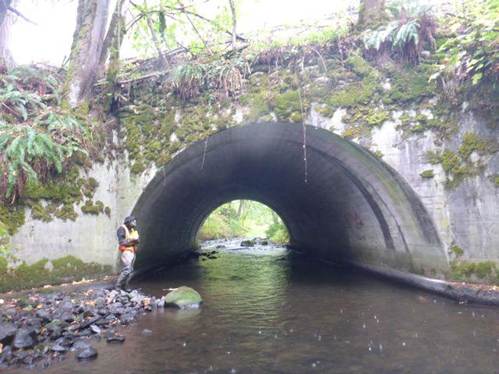
Newaukum Creek at 400th St SE (WDFW Site 934360): a velocity barrier to nine species, from steelhead to Chinook. Replacement estimate: $10.8 million. Retrofit estimate: under $10,000.
Where the tool fits — and where it doesn’t
Not every one of these sites is a FlexiBaffle candidate, and the honest version of this story matters more than the headline number.
Baffles work where the barrier is inside the barrel — velocity too high, water too shallow. Little Soos Creek (a 36-inch concrete pipe, passable only a third of the time on depth) and Watercress Creek (twin 48-inch barrels, a velocity barrier) are exactly that: a few thousand dollars each to move fish that currently can’t get through.
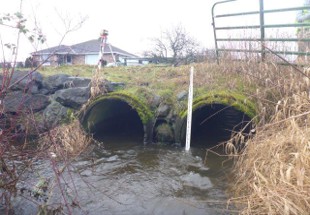
Watercress Creek (WDFW Site 880003): Two 48-inch concrete culverts blocking fish passage on Watercress Creek. Retrofit estimate: $4,160 – against $1,873,840 for replacement.
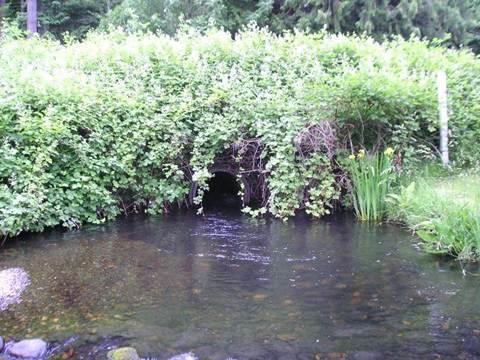
Little Soos Creek (WDFW Site 810110): a 36-inch pipe blocking passage on depth. Retrofit estimate: $1,248 — against a $5.8 million replacement.
Baffles do not fix what happens at the ends of the pipe. Two of these sites — a box culvert on Ames Creek and an unnamed Snoqualmie tributary — are blocked by tidegates and floodgates. A baffle can’t open a flood door; that barrier has to be resolved first, and the retrofit only makes sense once it is. Jenkins Creek is a third caution: a 13.2% slope well outside FlexiBaffle’s design parameters, with a 4.3-foot drop at the outlet that is the real barrier. It appears in the table only as a site that would need a full hydraulic review — not as a success story.
That is the discipline the tool requires. FlexiBaffle addresses in-barrel velocity and depth. Full stop. Where a culvert is perched, gated, or dropping fish out the downstream end, the primary barrier comes first.
About the baffles
The baffles are EPDM synthetic rubber — not plastic. Non-toxic, fully recyclable, no 6PPD-quinone, and manufactured in the U.S. from American-sourced materials. They flex flat under high flow so debris passes and hydraulic capacity is preserved, then spring back. Design life is 10 years for planning purposes, with 15-plus years observed in the field — which, not by accident, is about the length of a replacement funding queue. The system was developed in New Zealand, has thousands of installations worldwide, and is now in 15 U.S. states and four Canadian provinces.
The bottom line
The King County inventory isn’t an argument for retrofitting instead of replacing. It’s an argument for not making fish wait a decade for the replacement to be funded. Under one percent of the replacement cost buys passage in the meantime.
If you’re sitting on a barrier inventory — a county, a DOT, a watershed council, or an agency — send me the sites. I’ll tell you honestly which ones baffles will move fish through in the interim, and which ones need the primary barrier solved first.
Shane Scott
Principal Biologist · SSA Environmental
shane@ssaenv.com | ssaenvironmental.com | (360) 601-2391
