

NOAA Fisheries published Guidelines for Stream Crossings and Grade Control in July 2026 — 122 pages out of the West Coast Region’s Engineering and Physical Sciences Branch, and the new NOAA fish passage guidelines for the region. They replace three documents at once: the 2001 California salmonid passage guidelines with their 2019 and 2023 addenda, the 2022 Oregon, Washington and Idaho guidelines with the 2023 addendum, and the 2011 Northwest Region Anadromous Salmonid Passage Facility Design manual.
In practice, that consolidation is the headline for anyone who designs, permits, or funds stream crossings on the West Coast. If your design memo, grant application, or product literature cites any of those three documents, the citation is stale. Mine were.
The second headline, and the reason I went back through the document a second time: culvert baffles now have their own section.
What the guidelines are built around
Chapter 2 sets the preference hierarchy that governs everything downstream of it. In order: avoid the crossing entirely by realigning the road; remove the crossing and restore the stream; span the channel migration zone with a bridge; use Stream Simulation Design under Chapter 3; or use Hydraulic Design under Chapter 4.
Chapter 6 sits outside that list. It is titled “Design Alternatives Requiring Pre-Consultation,” and it covers culvert retrofits, fishways, and low-water crossings. §6.1 authorizes retrofits at crossings that will not be removed or replaced in the immediate future, with Hydraulic Design as the stated objective.
That is the doctrinal frame, and it is worth stating precisely: a retrofit is not one of the ranked design alternatives. It is a treatment for a crossing that is going to remain in place for a while, applied so that fish can use it in the meantime.
Where FlexiBaffle fits — §6.1.2
This is where the new NOAA fish passage guidelines do something the prior three documents never did. §6.1.2 is the section that names baffles, and three provisions in it carry the weight.
First, NOAA may approve the use of baffles in a permanent installation for the specific location. Permanent — not provisional, not temporary-only. A written pathway to permanent approval now exists where it did not before.
Second, baffles may provide incremental fish passage improvement in culverts with excess hydraulic capacity. Incremental. The agency has stated in writing that partial gains count, which means a retrofit no longer has to clear an all-or-nothing bar to be worth proposing.
Third, the conditions. A maintenance plan combined with adequate long-term funding and assurances. Inspection before each migration window and after any flood greater than a two-year exceedance. And compelling evidence of successful passage at other sites using a similar design.
None of that is an endorsement. NOAA permits baffles conditionally, and pre-consultation is required. What changed is that the tool is named, the conditions are written down, and the pathway ends somewhere other than a temporary permit.
What §6.1.2 doesn’t change
Replacement is the superior long-term outcome and it stays the objective. It restores geomorphic process — sediment transport, wood passage, channel migration — and a baffle delivers none of that. The Chapter 2 hierarchy is right, and baffles earn no geomorphic credit in watershed-scale recovery accounting. What a baffle does is move fish through a barrel while the replacement queue advances. Different job, different timescale.
The scope limit decides which sites qualify, so it belongs here: baffles address in-barrel velocity and depth. They do not fix outlet drops, perched inlets, or floodgates. Where the primary barrier is one of those, it has to be resolved first, and no amount of in-barrel work substitutes for that.
The evidence condition is the one that decides your project
§6.1.2 asks for compelling evidence of successful passage at other sites using a similar design. That is an evidentiary demand rather than a hydraulic one, and it is where most pre-consultations turn. Here is the file we bring.
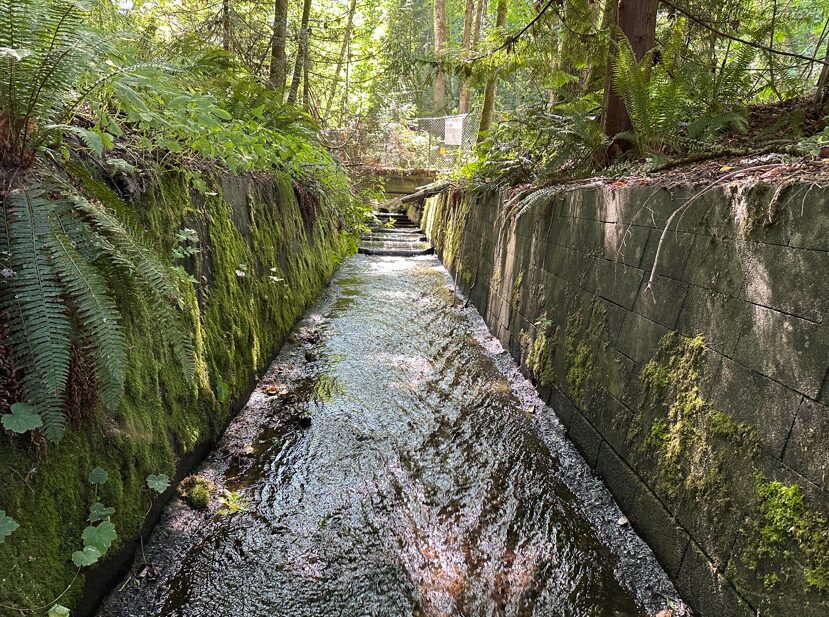
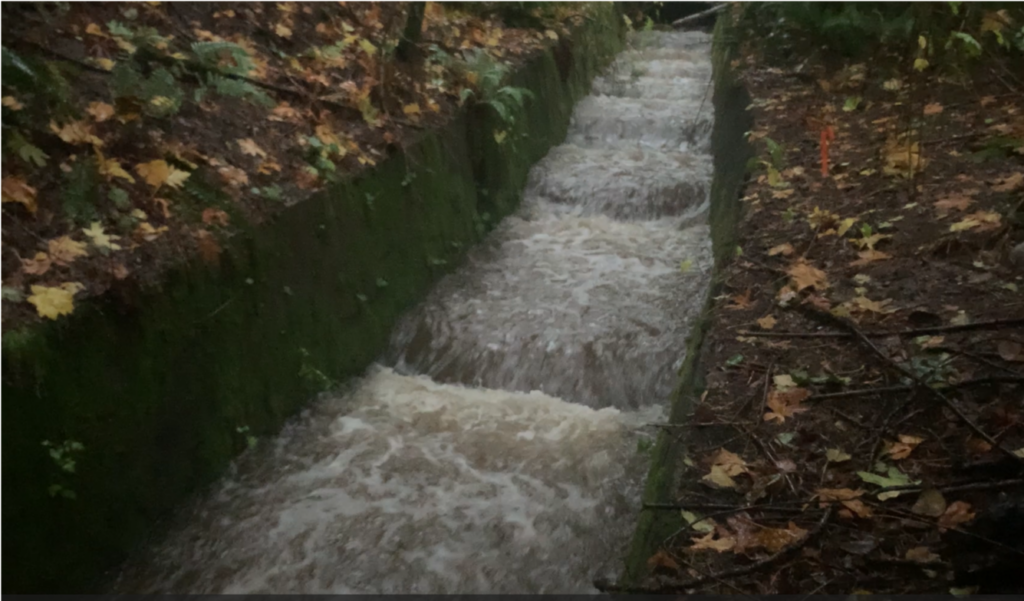
Bon Accord Creek, Surrey BC — roughly sixty six, 2-meter FlexiBaffles in a 500-foot concrete flume, installed with student volunteers.
Bon Accord Creek, Surrey, British Columbia. A 500-foot concrete flume blocked passage for roughly seventy years. We installed about sixty six, two-meter FlexiBaffles with student volunteers. After the first significant November rainfall, an adult coho was observed above the structure. The following June, juvenile coho — the first in nearly seventy years. Approximately 2.5 kilometers of habitat reconnected. It is the largest FlexiBaffle installation in North America.
Ketchikan, Alaska. Fish moved into the culvert within two hours of watering up.
Quebec. The installation held through −20 °C and came through spring melt fully intact and operational.
Johnson Creek Watershed Council, Oregon. The first North American installation, 2018. Three sites since.
WSDOT SR 9. A state DOT installation.
Beyond the Pacific Northwest: NY DEC’s Cook’s Brook, a peer-reviewed brook trout reconnection study, and a letter of support from the Pennsylvania Fish and Boat Commission. The system was developed in New Zealand, has thousands of installations worldwide, and is now in fifteen U.S. states and four Canadian provinces.
Hydraulic capacity and debris — the objection, answered
NOAA’s stated rationale for placing baffles where it did is specific: many baffle designs reduce hydraulic capacity and increase clogging and debris accumulation.
That rationale is correct, and it describes rigid baffles. Concrete and steel baffles are fixed obstructions. They shrink the barrel and they catch wood. That is the failure mode that historically limited the technique, and it is the exact problem a flexible weir was built to solve.
By contrast, a FlexiBaffle bends flat under high flow, passes wood and rock through the barrel, and reorients as flows recede. That is not a mitigating feature bolted onto the design. It is the design.
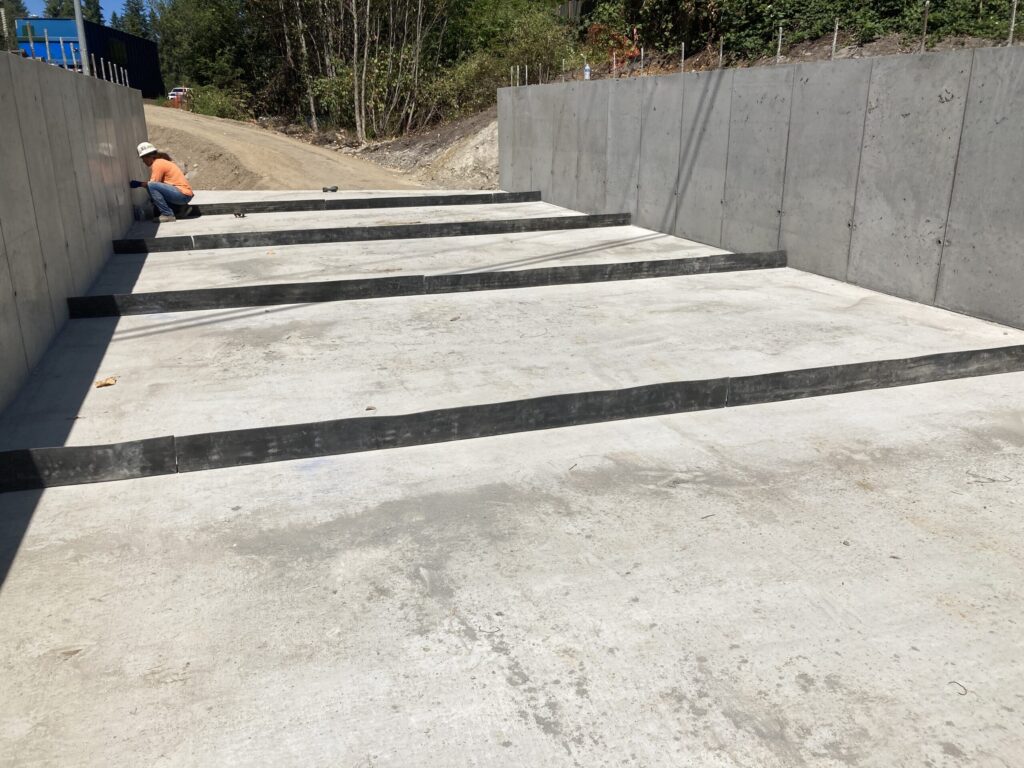
One line is worth drawing carefully. §5.4.3 recognizes deformable weirs — structures that stay stable at the fish passage design flow and deform above it — and that is a functional description of a 75-durometer EPDM baffle. But §5.4.3 sits in Chapter 5, which addresses channel-spanning grade control, and its examples are wood and rock. FlexiBaffle is not a §5.4.3 deformable weir, and I do not argue that it is. The shared design principle is the argument, and it is the one that survives a reviewer’s read.
Under these guidelines the capacity and debris performance has to be shown rather than asserted — two-dimensional modeling and monitored site data. §7.4 also does not allow trash racks to shield baffles without prior approval, so the debris case has to be made on the baffle itself.
Interim is the default status. It is not the ceiling.
Notably, baffles come out when the culvert comes out. Installation is a day’s work for a two-person crew with hand tools — no dewatering, no traffic closure, the structure left intact. Self-tapping screws in CMP and HDPE; wedge anchors in concrete that do not fully penetrate the structure. The EPDM carries a 10-year design life for planning purposes, with 15-plus years observed in the field. None of that forecloses a future Stream Simulation project, which is a large part of why the tool is defensible at all.
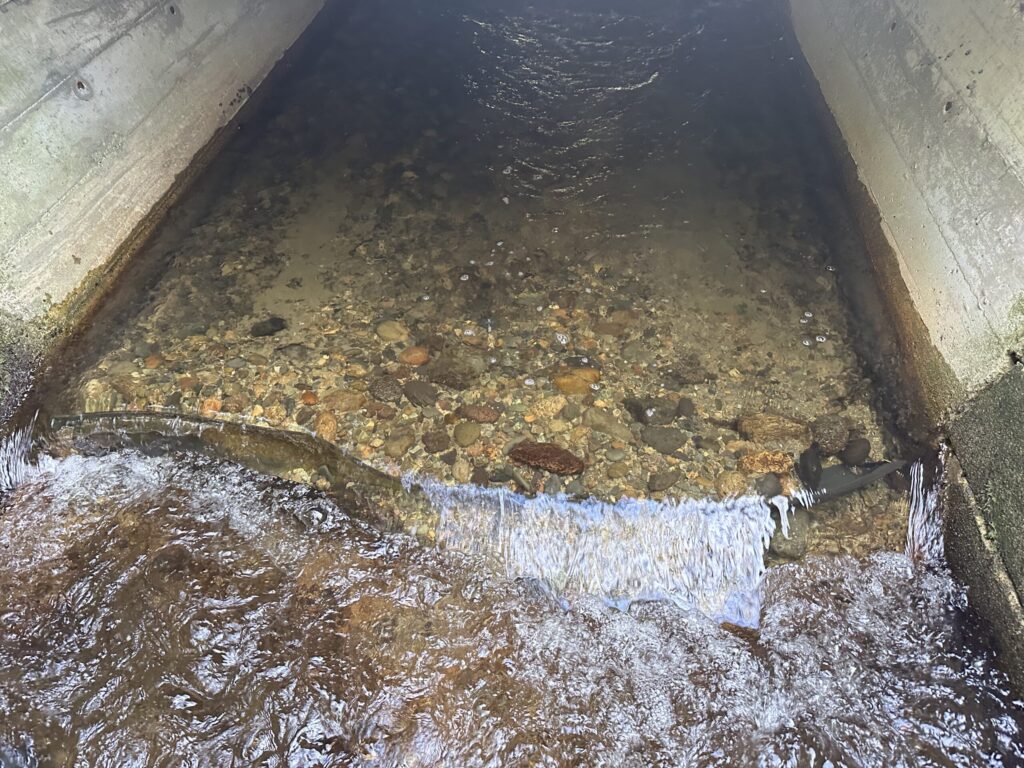
§7.1.2 requires interim passage plans when fish are present during construction, which is its own use case for a retrofit that installs and removes quickly inside a phased replacement program.
But interim is the default status under §6.1.2, not a limit written into the product. The permanent-installation pathway is in the text, and overstating the limitation concedes more than the regulator does.
What a retrofit costs, and what that buys you
Of course, the conditions in §6.1.2 are real, and meeting them takes work. What makes that work worth doing is the arithmetic on the other side.
We priced six King County culverts against their programmed replacement cost, using the WDFW fish passage inventory for site geometry and manufacturer sizing tables at $52 per linear foot of baffle. Every one of these six is a velocity or depth barrier inside the barrel — the condition baffles are built to treat.
| Site (WDFW ID) | Baffle material | Replacement | Ratio |
|---|---|---|---|
| Newaukum Creek / 400th St SE (934360) | $9,984 | $10,845,000 | 0.092% |
| Ames Creek / NE 80th St (101A-11) | $1,664 | $6,148,000 | 0.027% |
| Little Soos Creek / SE 240th St (810110) | $1,248 | $5,806,000 | 0.021% |
| Ames Creek / NE 100th St (101A-30) | $6,760 | $3,379,000 | 0.200% |
| Daniels Creek / 185th Ave NE (932617) | $936 | $4,127,000 | 0.023% |
| Watercress Creek / SE 432nd St (880003) | $4,160 | $1,878,000 | 0.222% |
| Six-site total | $24,752 | $32,183,000 | 0.077% |
$24,752 of baffle material against $32,183,000 of programmed replacement cost. That is 0.077 percent. The widest single-site ratio in the set is Watercress Creek at 0.222 percent, and not one of the six reaches a quarter of one percent.
Importantly, those two columns are not measuring the same thing, and the comparison is only useful if you know that. The retrofit column is material only. The replacement column is full project cost — design, permitting, traffic control, construction, contingency. Add a crew day and a funded inspection program to the left column and the ratio moves. It does not move anywhere near one percent.
Ultimately, what that ratio buys is reach. A jurisdiction holding four hundred barriers with a program that funds three or four replacements a year is not choosing between a retrofit and a replacement at one site. It is choosing what happens at the other three hundred and ninety-six while the queue advances. Chapter 6 asks which action delivers the greatest net benefit for fish passage, and at that scale the answer is not close: the same money that moves one crossing to the front of the replacement list can open in-barrel passage at dozens.
Every closed season at those sites is lost production. Time-to-passage is itself a conservation metric, and it is the one a retrofit moves fastest.
One thing to get right before you write the submittal
Approval under §6.1.2 is conditioned on a maintenance plan “in combination with adequate long-term funding and assurances,” and for permanent approval that funding must extend over the life expectancy of the facility.
So the cost argument has to be made in the right direction. An applicant who argues that replacement is unaffordable has argued themselves out of eligibility — the section conditions approval on demonstrated funding capacity. The figures above are not an affordability case. They are a portfolio case, and the difference decides how the pre-consultation goes.
The sentence that works is this one: we have funded the maintenance obligation, and this is where the marginal dollar buys the most passage soonest.
Where this leaves you
If you manage a barrier inventory and you are heading into pre-consultation under the new guidelines, the sequence that works is straightforward. Build the evidence file before the hydraulic memo, because §6.1.2 turns on it. Bring the funded maintenance and inspection program to the first meeting rather than the last. Model in two dimensions. And screen your inventory for the barrier type first, so the sites you bring forward are the ones baffles actually treat.
Happy to walk your staff through the hydraulics — the Manning’s n values, the sizing tables, the debris behavior, and the sites where I will tell you this is the wrong tool.
Shane Scott, Principal Biologist · SSA Environmental
shane@ssaenv.com | ssaenvironmental.com | (360) 601-2391